# Loner - Core Rules 2nd Edition (Legacy)
Roberto Bisceglie
2026-07-31
# Loner - Core Rules 2nd Edition
## What is Loner?
***Loner*** is a minimalist Solo Role Playing Game designed to be played
with only one character (the Protagonist). You’ll guide them through the
story that will unravel during the game, asking closed questions to an
Oracle which will help you overturn your expectations. Every now and
then you will be surprised with an unexpected twist!
*Loner* follows the following design principles: 1. **Portable**: to
play you will need a few common (six-sided) dice and writing materials.
Anything else is optional and not essential. 2. **Rules-Light**: the
game relies on a few rules and only one solving mechanic, easy to learn
and eventually to memorize. 3. **Tag-based**: characters and situations
are defined only by qualitative descriptors and no quantitative
characteristics. 4. **Generic**: you can play anything, yet the game is
not universal. It is designed for quick resolutions, without tactical
depth or simulationist ambitions.
## What is a Role Playing Game (RPG)?
A role-playing game (RPG) is a type of game in which players assume the
roles of fictional characters and act out their actions and decisions
within a narrative or imaginary setting. The outcome of these actions
and decisions is often determined by a set of rules and game mechanics,
such as dice rolls or statistical attributes of the characters. Players
may also collaborate to create a shared story or narrative through their
characters’ actions and interactions.
## What is a Solo RPG?
In a solo RPG a single player takes on the roles of one or more
characters, while also simultaneously managing some elements of the game
world. These games typically involve the use of a rule system and game
mechanics to determine the outcome of actions taken by the
player-controlled characters. Unlike a gamebook (such as the Fighting
Fantasy, Lone Wolf, and Tunnels & Trolls series) a solo RPG is not a
form of interactive, forked narrative in which outcomes are
pre-determined and limited by the author’s choices.
Through the interaction of player, oracle, tools, and prompts, the
character’s actions will build an **emergent narrative** within whose
boundaries anything can be attempted, without predetermined limits.
## Safety Tools
You will play alone, but be sure to play in an environment that is
comfortable for you, without overexerting yourself, and reserve the
option to stop as soon as you feel uncomfortable for any reason,
physical or emotional. Don’t be afraid to tackle new themes, but do so
in full awareness of your boundaries.
## Minimum Requirements
To play *Loner* you will need: - **4 six sided dice** (also known as
d6s): two pairs of different colors - **Paper and writing tools**: at
least a sheet of scrap paper and and pencil, but index cards or sticky
notes are a fine addition - **Character sheet**: you may use the
provided sheet at the back or a simple index card. - **Notebook**:
*Loner* is not a solo journaling game, you can easily play it in the
“theater of mind”. But you can keep track of you game if you feel the
need!
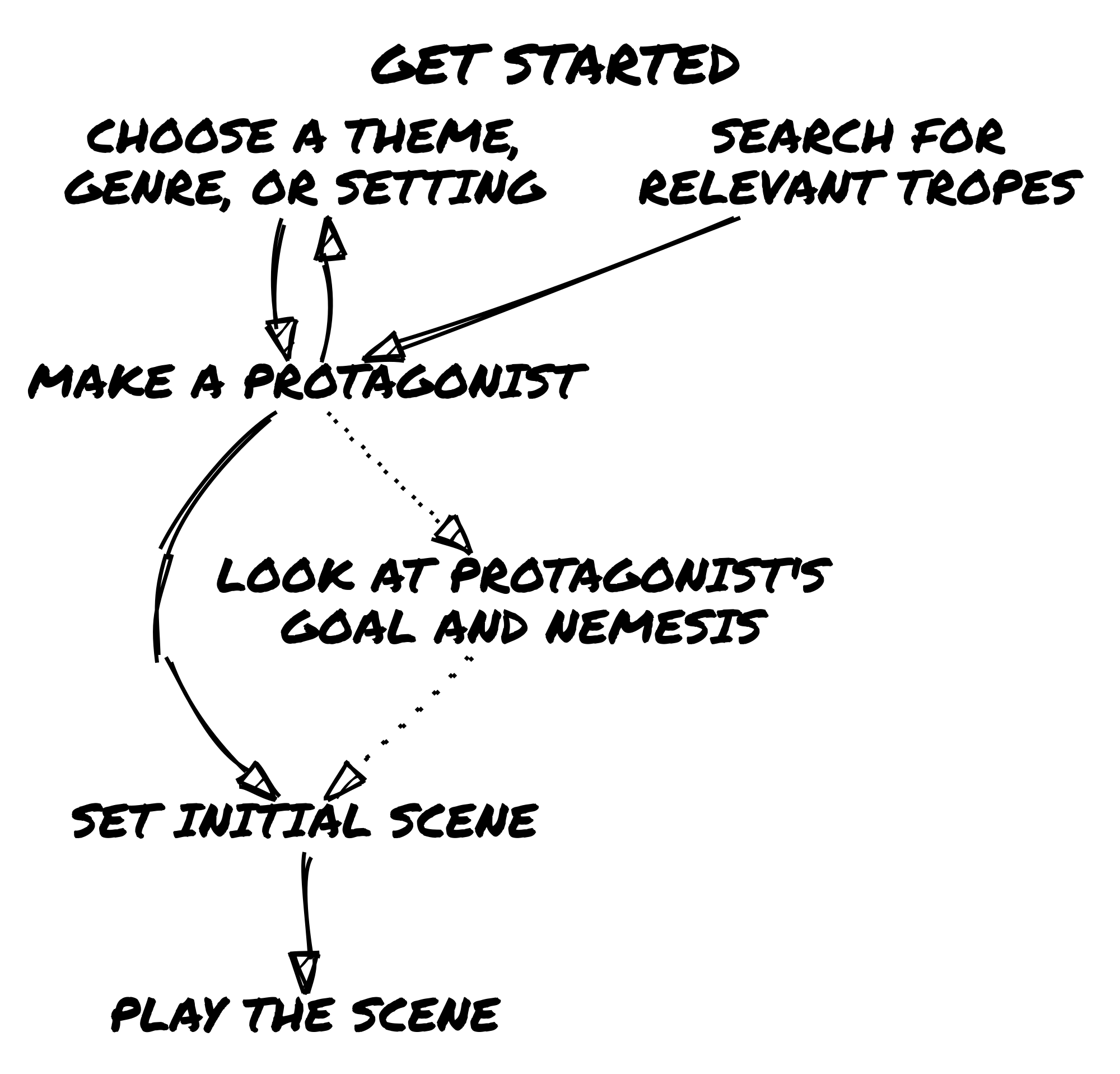
## Choose a genre or setting
A Loner adventure takes place in a well-defined imagery that you will
have to choose from: your favorite TV series, a book saga you are
reading, an RPG setting you like, a genre you are familiar with or
instead want to start exploring.
You can also consult lists of tropes (google them) to generate randomly
and then choose!
Or you can use the Adventure Packs found in the second part of the
volume.
You can also generate the character first, based on randomly chosen
tropes, and once it is defined, you can follow the genre that emerged at
this stage.
## Make Your Protagonist
Once the setting is established, now is the time to create your
Protagonist.
Your Protagonist is described by some fixed traits:
- **Name**: The name should be iconic and consistent with the tone and
setting of the story.
- **Concept**: A concise description of the character’s profession,
background, and abilities. The best are adjective-name pairings, like
*“Venturous Smuggler”* or *“Child Prodigy”*.
- **Skills** (x2): Abilities not necessarily character-specific but not
characteristics common to all. *“Smart”* is not a skill, *“Engine
Whisperer”* is.
- **Frailty**: Something that could potentially get in the way of the
character, either physically, mentally, or socially.
- **Gear** (x2): Particular equipment supplied to the character in
coherence with the setting. Everyday items are taken for granted and
do not fall under this trait.
- **Goal**: The long-term objective.
- **Motive**: What drives the pursuit of the goal.
- **Nemesis**: A person or organization that hinders the protagonist. It
can emerge during the first game sessions, it may or may or not be the
direct antagonist of the story, ready to appear to make life even more
difficult
- **Luck**: The measure of a character’s ability to avoid ill fortune or
an inauspicious outcome. It applies only in Conflicts and
automatically recharges when they end. Luck starts and caps at 6.
**Example** \> **Zahra Nakajima** Witty Street Cat. Streetwise, Nimble,
Merciful.\
\> Knife, Low O2 Supplement.\
\> She wants to obtain unknown technology to save her planet from
atmosphere collapse.\
\> **Nemesis**: The Naturalist Order\
\> **Luck**: 6
## Everything is a Character!
In *Loner* Non-Playing Characters (NPCs), Foes, Organizations, Monsters,
and even relevant objects like vehicles are characters too!
- **Living Character** follow the same rules of generation as the
Protagonist.
- **Non-Living Characters**, instead, do not have a goal, a motive, nor
a nemesis.
**Example** \> **The Century Skylark** Spacecraft in bad shape.
Hyperjump Drive, Camouflage Circuits, Midlife Courier.\
\> Shields, Turrets.\
\> **Luck**: 6.
## Descriptive Tags
Tags are descriptive words or phrases that could be identify anything in
the game world. They fall roughly into the following categories: -
**Character Traits**: as seen above, they describe a character’s skills
and flaws, their goal and motive. - **Details**: features of an
environment or scene that might change as a result of an action. -
**Conditions**: are physical, mental or social effects that impact the
way a character behaves or attempts actions.
Tags determine if there are sufficient prerequisites in the scene for
[Advantage or Disadvantage](#advantage-and-disadvantage). They are
qualitative representations. **They are not quantitative measures**.
## Before the Adventure
You can start directly to play your adventure, but it may be worthwhile
to make an extra effort.
By defining your Protagonist’s Nemesis you have already identified an
**NPC**! Write down their sheet and keep it aside.
Think about whether your Protagonist has allies or friends and throw
down their sheets as well.
Jot down these NPCs in a list, which you will consult when they need to
be recalled as a result of a [Twist](#determine-the-twist).
Also, it might be useful to jot down interesting **Locations** that
serve as settings for your Protagonist and keep a list of major
**Events** that happen during the game.
## Start Your Game
To begin an adventure in Loner you will need to determine the initial
scene:
1. You might think of a dramatic situation and start the game in the
middle of an action scene. This will push events forward, allowing
you to build the story as you go.
2. Otherwise, if you prefer to define a framework for the adventure you
can answer the classic questions, Who? What, Why? Where? How? Add
also an Obstacle to overcome.
If you find it difficult to answer any or all of the questions, the
following table provides prompts on which to build your adventure.
| D6 | Who?
The proposer | What?
The mission | Why?
The incentive | Where?
The target | How?
The seed | Obstacle?
The complication |
|:--:|:--:|:--:|:--:|:--:|:--:|:--:|
| 1 | Authority | Rescue | Help | Person | Casual encounter | Opposition |
| 2 | Organization | Protection | Fortune | Group | Old acquaintance | Deception |
| 3 | Ally (friend, relative) | Exploit | Coercion | Treasure | Rumors | Environment |
| 4 | Mentor | Explore | Impulse | Location | Capture | Disguise |
| 5 | Help-seeker | Escape | Ambition | McGuffin | Mishap | Time |
| 6 | Blackmailer | Pursuit | Revenge | Confession | Object (map, journal, letter) | Space |
**Example**\
\> **Who?** Mentor\
\> **What?** Exploit\
\> **Why?** Help\
\> **Where?** McGuffin\
\> **How?** Rumors\
\> **Obstacle?** Time\
\> Tobias Wethern took Zahra under his wing when her parents died.
That’s why she can’t say no to him now. Tobias wants Zahra to steal a
datapad from the Leton Corporation’s subsidiary. He doesn’t know
precisely where it is stored, but that in 24 hours it will be taken from
the company’s security corps to be transferred to another location.
## Keep The Action In Motion
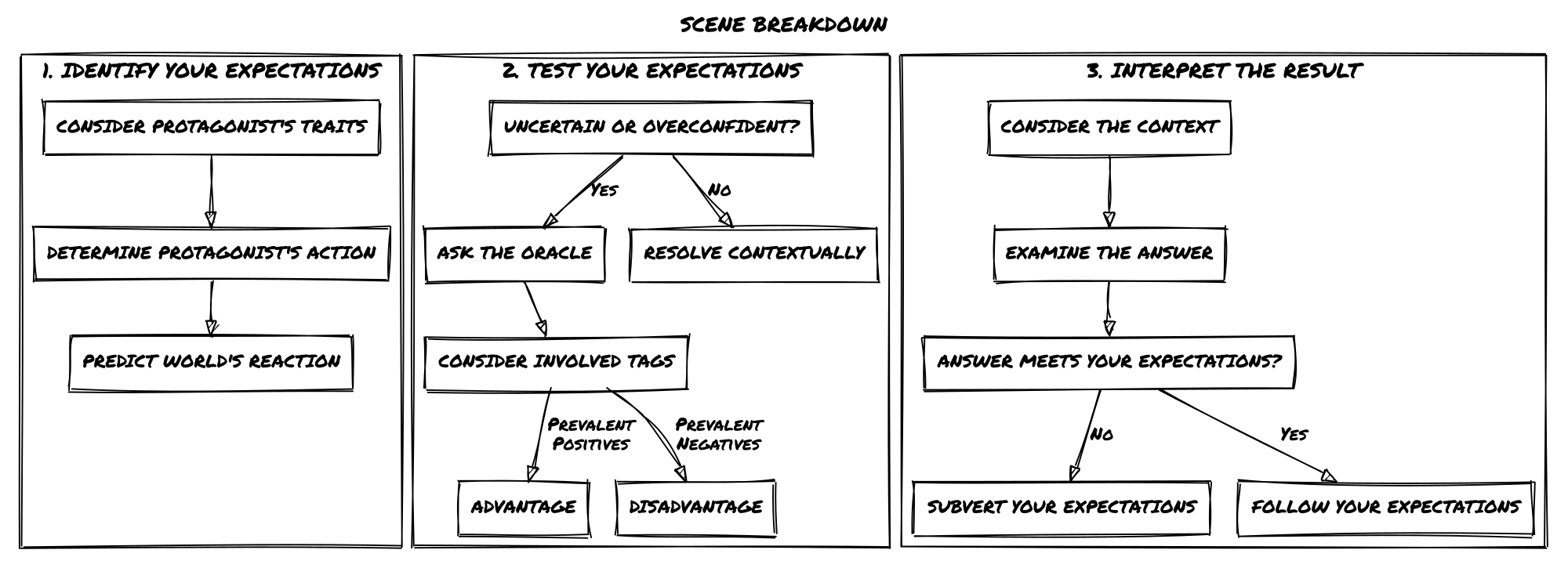
A game in *Loner* is a succession of scenes. A scene is a unit of time
in which a certain action takes place in pursuit of a certain short-term
goal.
In *Loner* at each scene: 1. **Identify what you expect from the
scene**. Compared to traits, goal, and motivation determine the
Protagonist’s action. What might be the reaction of the game world? 2.
**Test your expectations**. When you are uncertain (or overconfident)
about the reaction to your actions, [ask the
Oracle](#consulting-the-oracle) a closed question (answer is Yes or No),
considering the tags involved to determine if there is an [Advantage or
Disadvantage](#advantage-and-disadvantage). 3. **Interpret the result**.
Is the Oracle’s answer in line with your expectations? If not, in the
context in which the scene takes place, how should an answer that
subverts them be considered?
This sequence will come to you naturally after some practice. Use it as
a guideline the first few times.
## Identify Your Expectations
The Protagonist’s traits characterize their behavior within the
fictional world and suggest the possible actions they takes in the
situational context of the scene.
Based on this, you can expect the world to react in the most logical
way, and you will formulate a question that tests this expectation.
An expectation does not necessarily automatically lead to a question,
which you need to ask only when there are concrete risks or you want to
be amazed. In other cases, simply let events happen.
**Example**\
\> Zahra sneaks into the Leton Corporation subsidiary. The expectation
is that the place will be well guarded during the day and less so at
night. To escape an inevitable head-on collision, Zahra decides to act
at night and enter through the ventilation ductsYou don’t expect there
to be an alarm but maybe it’s worth asking the question!
## Consulting the Oracle
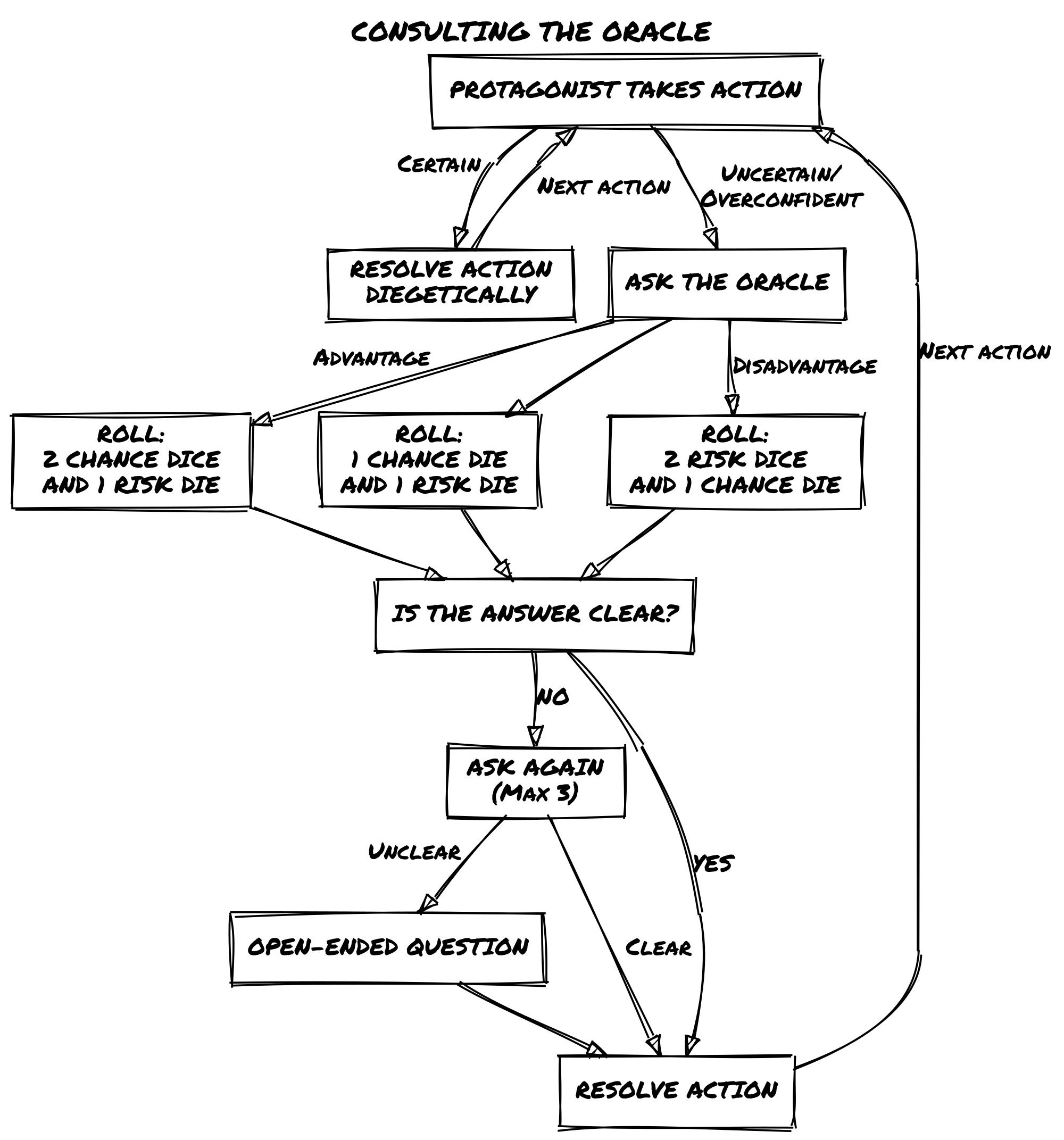
When you need to test your expectations you’ll ask the Oracle a closed
question.
You’ll need 2d6 in one color (**Chance Dice**), and 2d6 in another
(**Risk Dice**).
To resolve a closed question, roll one **Chance Die** and one **Risk
Die**: - If the Chance Die is highest, the answer is **Yes**. - If the
Risk Die is highest, the answer is **No**. - If both are low (3 or
less), add a **but…**. - If both are high (4 or more), add an
**and…**. - If both are equal, the answer is **Yes, but…**. Add a point
to the **[Twist Counter](#twist-counter)**.
| Dice Value | Chance Die \> Risk Die | Risk Die \> Chance Die |
|:----------:|:--------------------------:|:----------------------:|
| Both \< 4 | Yes, but… | No, but… |
| Both \> 3 | Yes, and… | No, and… |
| Mismatched | Yes | No |
| | | |
| Equal | Add 1 to the Twist Counter | |
**Example** \> You ask, “Does Zahra manage to force the hatch?” You roll
one Chance Die and one Risk Die and get (5) \[4\]). The answer is
**Yes**, because the Chance Die is higher. You also add **And**, because
both rolls are 4 or higher. If the Risk Die had come up as \[3\], it
would have been a plain **Yes** instead.
## Advantage and Disadvantage
If circumstances or positive tags grant an advantage, add a **Chance
Die** to the roll. Otherwise, when hindrances or negative tag cause a
disadvantage, add a **Risk Die**. In both cases keep only the higher die
of the added type when you check the roll.
Consider tags **intuitively and not quantitatively**, using the context
of the situation at play. It is important to keep the flow of play fast
and not accounting for advantages and disadvantages numerically!
**Example** \> You ask, “Does Zahra hack the datapad?” You roll one
Chance Die and two Risk Die, as Zahra does not have any advantage in
hacking and the datapad is the mission goal, compromising it would cause
the mission to fail. You get (5) \[3\] \[4\]. You discard the lower Risk
Die \[3\] and keep (5) and \[4\]. You obtain a **Yes** and add a **And**
since they are both 4 or higher.
## Interpreting the Oracle
Always interpret the Oracle’s answer in relation to the context of the
game situation:
- Answers without modifiers are straightforward answers without
uncertainty. They are also the least interesting to continue the
story.
- Answers with modifiers (but…/and…), on the other hand, require you to
make the effort to identify what new situation triggered the
consultation.
**Example**\
\> The datapad is hacked *and…* the information contained is not just
about illicit activities of the Leton Corporation… There is more!
## Sibylline Responses
The Oracle might sometimes give answers that don’t make sense in the
context of the scene. Don’t be tempted to detail the answer with too
many questions in sequence. Three questions should be sufficient. If
you’re still stuck, try using an open-ended question to unlock yourself
or interpret the answer as “Yes, But…” and move the story forward.
## Twist Counter
The Twist Counter is a measure of the rising tension in the narrative.
At the beginning is set to 0. Every time a double throw (dice are equal)
happens, add 1 to the Counter. If the Counter is below three, consider
the answer as “**Yes, but…**”. Otherwise a **Twist** happens and resets
the Counter.
**Example** \> You ask if the datapad contains sensitive data about
Wethern’s illicit activities. You roll (4) \[4\]. The answers is “Yes,
but…”. Zahra finds a note about a scapegoat to frame for the theft.
Could it be her? \> You also add 1 to the Twist Counter. But the counter
was already at 2, so also a twist happens! The counter resets to 0.
## Determine the Twist
Roll 2d6 and consult the following Twist Table to determine what kind of
twist happens.
| D6 | Subject | Action |
|:---:|:------------------:|:-------------------:|
| 1 | A third party | Appears |
| 2 | The hero | Alters the location |
| 3 | An encounter | Helps the hero |
| 4 | A physical event | Hinders the hero |
| 5 | An emotional event | Changes the goal |
| 6 | An object | Ends the scene |
Interpret the two-word sentence in the context of the current scene.
Twists will keep the plot and events going in unexpected ways.
> Now Zahra knows the content of the datapad, but you roll 1 and 5 on
> the Twist Table “*A third party*”, “*Changes the goal*”. An agent of
> the Leton Corporation appears before Zahra with a proposal….
## Conflicts
A *Conflict* is any situation in which opponents clash, attacking,
defending, or wearing each other down in order to win. This applies both
in a practical and metaphorical sense.
So, a Conflict is not only limited to combat (or fighting) in the strict
sense but also to competitive situations (such as contests, duels,
verbal confrontations, etc.) in which two or more characters (including
vehicles, of course!) compete.
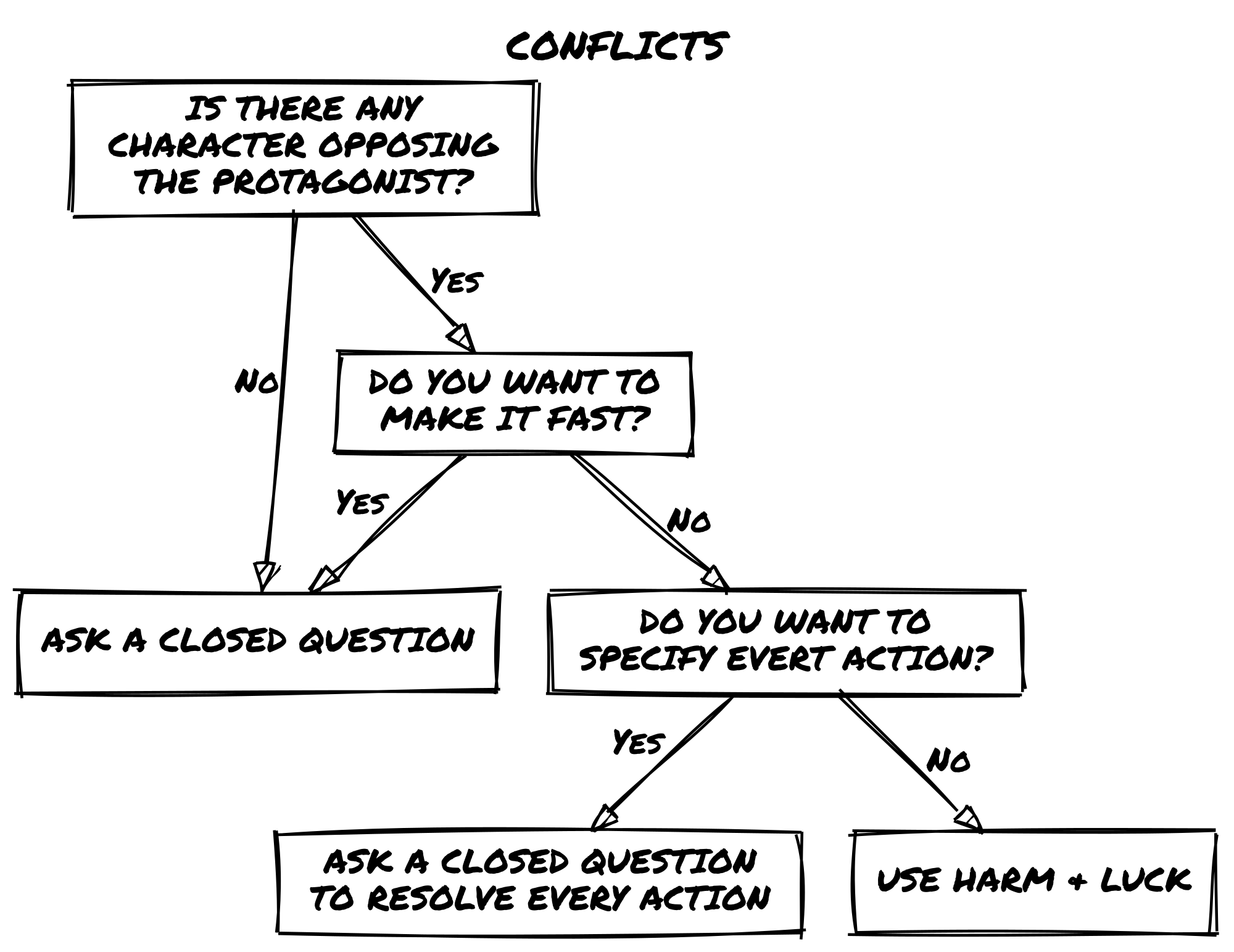
Conflicts can be resolved in different ways depending on preferences and
context: 1. Ask a single closed question. The Oracle’s answer determines
the outcome of the conflict. 2. Ask a series of closed questions to
resolve current single actions. 3. Use the rules of Harm & Luck below.
Note that the Twist Counter **does not apply** to Harm & Luck. Instead,
it is used regularly if the Conflict is handled with closed questions.
## Harm & Luck
If the conflict is resolved by applying damage to the Luck trait, roll
the dice to determine whether the protagonist causes damage to the
opponent or suffers damage due to counterattack or failed defense. The
rolls are player facing only.
The damage reduces the Luck of the target, whether protagonist or NPC.
When the Luck runs out, the character has lost the conflict.
The final outcome depends on the context. Do you get caught? Are you
seriously injured? You may even die if that fits the narrative.
| Answer | Do you get what you want? | Harm |
|-----------|---------------------------------------------------------|---------|
| Yes, and… | You get what you want, and something else. | Cause 3 |
| Yes… | You get what you want. | Cause 2 |
| Yes, but… | You get what you want, but at a cost. | Cause 1 |
| No, but… | You don’t get what you want, but it’s not a total loss. | Take 1 |
| No… | You don’t get what you were after. | Take 2 |
| No, and… | You don’t get what you want, and things get worse. | Take 3 |
**Example** \> Zahra confronts a thug in an alley. He is “Martial
Artist”, “Hand-to-Hand Combat”, “Feline” and “Short”. Zahra tries to hit
him with the knife, you throw (5) (6) \[4\] (“**Yes, And…**”, causing a
Luck loss of 3 to the thug). The thug throws a roundhouse kick at Zahra
(roll (3) (2) \[2\], “**Yes, but…**”, causing a Luck loss of 1 to
Zahra). Who will win?
## Determine the mood of the next scene
At the end of the current scene sometimes you will be clear about the
direction to take, other times you may need to determine the general
mood of the next one. In this case roll 1d6 and consult the following
table:
| D6 | Next Scene |
|:---:|:--------------:|
| 1-3 | Dramatic scene |
| 4-5 | Quiet Scene |
| 6 | Meanwhile… |
- A **dramatic scene** does not break the tension of the previous scene
but carries it further forward, introducing further obstacles or
difficulties.
- During a **quiet scene** there is time to take a breath, to heal, to
make plans for the next steps and to deepen relationships.
- A **meanwhile scene** takes place somewhere else, other than where the
hero is. It cuts to villains or other plot-important characters.
**Example** \> Zahra accepts the proposal, you now roll for the next
scene: 6, *Meanwhile scene*. In the following scene, Tobias Wethern
hires a hit man to kill Zahra…
## Open-Ended Question or Get Inspired
To answer an Open-Ended question, roll 1d6 once on each of the following
tables (roll at least a verb and a noun, adjectives are optional).
| Verbs | 1 | 2 | 3 | 4 | 5 | 6 |
|:-----:|:--------:|:------:|:-------:|:--------:|:-------:|:-------:|
| 1 | inject | pass | own | divide | bury | borrow |
| 2 | continue | learn | ask | multiply | receive | imagine |
| 3 | develop | behave | replace | damage | collect | turn |
| 4 | share | hand | play | explain | improve | cough |
| 5 | face | expand | found | gather | prefer | belong |
| 6 | trip | want | miss | dry | employ | destroy |
| Adjectives | 1 | 2 | 3 | 4 | 5 | 6 |
|:--:|:--:|:--:|:--:|:--:|:--:|:--:|
| 1 | frequent | faulty | obscene | scarce | rigid | long-term |
| 2 | ethereal | sophisticated | rightful | knowledgeable | astonishing | ordinary |
| 3 | descriptive | insidious | poor | proud | reflective | amusing |
| 4 | silky | worthless | fixed | loose | willing | cold |
| 5 | quiet | stormy | spooky | delirious | innate | late |
| 6 | magnificent | arrogant | unhealthy | enormous | truculent | charming |
| Nouns | 1 | 2 | 3 | 4 | 5 | 6 |
|:-----:|:----------:|:-------:|:------:|:------:|:---------:|:--------:|
| 1 | cause | stage | change | verse | thrill | spot |
| 2 | front | event | home | bag | measure | birth |
| 3 | prose | motion | trade | memory | chance | drop |
| 4 | instrument | friend | talk | liquid | fact | price |
| 5 | word | morning | edge | room | system | camp |
| 6 | key | income | use | humor | statement | argument |
**Example** \> You ask: “Does Zahra have friends to ask for help against
the hit man?”. You roll 24 and 32: *multiply motion*. Zahra needs to
move quickly to reach Melina Reade, a hacker with contacts in the
underworld who might be able to help her!
## When the story ends
At the end of the adventure you may add another trait to the character.
It is better that this is related to how the story just ended and can be
either a Skill, Gear, a new Frailty, or even a new Nemesis! You can also
modify an existing trait to better represent an enhanced expertise.
Also update the list of **NPCs**, **Locations**, and **Events** that may
show up again in future adventures.
**Example** \> Zahra secures the datapad in the hands of the
authorities, framing both Wethern and the Leton Corporation. Wethern is
arrested, but she has gained a powerful enemy working against the
Corporation. She gains “Wannabe Hacker” to her skills. Maybe Melina can
mentor her!
## Loner Together
Loner’s rules are designed for a single player controlling one
character. However being derivative of a multiplayer game (Freeform
Universal) no one prevents you from using them for group play as well,
if you insist on doing so.
It is then possible to play in the following modes: 1. **without a game
master**: you play as in solo mode, each person controls their own
character and asks questions to the Oracle in solo play. The Oracle’s
answers and the game world’s reactions are interpreted by the player who
asks the current question. Facilitator functions (moderating the flow of
play and possibly settling disputes between players, as well as
reminding players of the rules) can be taken on by a single player at
the table, or they can be rotated. Questions pertaining to the entire
group of character can be concerted. 2. **with a game master**: they
always pull only the players questioning the Oracle as in the solitary,
no-master mode. The master takes charge of interpreting the answer and
presenting the reactions of the game world. He also assumes the
functions of a facilitator.
Keep in mind that as much as Loner can be played in groups, I strongly
recommend that you use Freeform Universal for this need.
## The Adventure Maker
Sometimes you may lack the inspiration to think of a game setting, or
you want to experiment with one you have never thought of. The tables
below are designed to instantly generate an unpredictable setting for
you to explore with a game.
To generate a setting: 1. Roll on the Settings table 2. Roll on the
Tones table 3. Roll two times on one Things table of your choice
To generate a premise of adventure: 1. Roll on the Opposition table 2.
Roll two times on Actions table and on a Things tables
Note that the adventure premise is not the initial scene prompt, only
the framework within which it takes place.
### Table 1: Settings
| | 1 | 2 | 3 | 4 | 5 | 6 | |
|----|----|----|----|----|----|----|----|
| 1 | Post-Apocalyptic Wasteland | High Fantasy Kingdom | Medieval War and Intrigue | Cyberpunk Megacorporation | Futuristic Space Colony | Supernatural Noir City | |
| 2 | Alternate History | Pirate-Filled Seas | Wild West Frontier | Dark Fantasy Realm | Futuristic Dystopian City | Ancient Greek Mythology | |
| 3 | Space Opera Adventure | Samurai-Era Japan | Zombie Survival | Superhero Metropolis | Cold War Espionage | Modern Crime Syndicate | |
| 4 | Magic School for Young Mages | Horror-Filled Asylum | Epic Fantasy Quest | Cybernetic Organisms and Androids | Lovecraftian Cosmic Horrors | Sword and Sorcery Adventure | |
| 5 | Urban Fantasy Underworld | Abandoned Space Station | Colonial America | Mythical Creatures and Legends | Martial Arts Action | Horror-Stricken Carnival | |
| 6 | Underwater Adventure and Exploration | Jungle-Covered Planet | Steampunk Victorian Era | Time Travel Paradoxes | Intergalactic Starfighter Battles | Survival in a Savage Land | |
| | | | | | | | |
### Table 2: Tones
| | 1-2 | 3-4 | 5-6 |
|----|----|----|----|
| 1 | Dark and brooding | Lighthearted and humorous | Gritty and realistic |
| 2 | Epic and grandiose | Suspenseful and thrilling | Mysterious and enigmatic |
| 3 | Action-packed and adventurous | Romantic and whimsical | Horror-filled and terrifying |
| 4 | Technologically advanced and sleek | Grungy and dirty | Gothic and ominous |
| 5 | Surreal and dreamlike | Futuristic and dystopian | Nostalgic and timeless |
| 6 | Eerie and paranormal | Martial and disciplined | Gracious and elegant |
### Table 3: Things
| | 1 | 2 | 3 | 4 | 5 | 6 |
|:--:|:--:|:--:|:--:|:--:|:--:|:--:|
| 1 | Magic | Monsters | Ancient relics | Medieval castle | Futuristic technology | Spaceship |
| 2 | Ancient ruins | Forbidden knowledge | Secret society | Dangerous quest | Band of adventurers | Unseen forces |
| 3 | Hidden treasure | Dark magic | Mystical creatures | Supernatural powers | Epic battle | Intriguing plot |
| 4 | Suspicious characters | War-torn land | Dangerous wilderness | Political intrigue | World domination | Suspenseful journey |
| 5 | Dark secrets | Forbidden love | Intense conflict | Death-defying stunts | Powerful artifacts | Epic journeys |
| 6 | Unpredictable twists | Dynamic characters | Different factions | Vast empires | Epic heroes | Legendary creatures |
| | 1 | 2 | 3 | 4 | 5 | 6 |
|:--:|:--:|:--:|:--:|:--:|:--:|:--:|
| 1 | Post-apocalyptic wasteland | Steampunk cityscape | Dragon-infested skies | Haunted mansion | Futuristic metropolis | Intergalactic trade routes |
| 2 | Lost city of gold | Artificial intelligence | Pirate’s cove | Time-travel paradox | Espionage | Extraterrestrial beings |
| 3 | Underwater kingdom | Epic sea voyage | Superheroic powers | Time loops | Alternate realities | Virtual reality simulation |
| 4 | Intriguing mystery | Mutant uprising | Advanced biotechnology | Futuristic society | Alternate history | Cyberpunk dystopia |
| 5 | Extensive lore | Unstoppable virus | Enchanted forest | The unknown frontiers | Advanced robotics | Secrets of the universe |
| 6 | End of the world scenarios | Telekinetic abilities | Futuristic weapons | Dimension hopping | Techno-sorcery | Superpowered conflict |
| | 1 | 2 | 3 | 4 | 5 | 6 |
|:--:|:--:|:--:|:--:|:--:|:--:|:--:|
| 1 | Lost civilization | Decaying metropolis | Gothic horror | Wild west frontier | Futuristic cyberwarfare | Space exploration |
| 2 | Political uprising | Artificial lifeforms | Mercenaries and assassins | Time-traveling adventures | Espionage mission | Alien invasion |
| 3 | Underwater adventure | Epic siege | Magical abilities | Time anomalies | Alternate timeline | Virtual reality nightmare |
| 4 | Intriguing conspiracy | Mutant insurgency | Cybernetic enhancements | Futuristic utopia | Historical reimagining | Cyberpunk rebellion |
| 5 | Extensive world-building | Unstoppable monster | Enchanted kingdom | The final frontier | Robotic revolution | Secrets of the ancients |
| 6 | End of the era scenarios | Psionic abilities | Futuristic battlefields | Interdimensional portals | Technomancy | Superpowered diplomacy |
### Table 4: Actions
| | 1 | 2 | 3 | 4 | 5 | 6 |
|:---:|:-----------:|:--------:|:----------:|:---------:|:---------:|:-------:|
| 1 | Cast | Battle | Free | Explore | Upgrade | Pilot |
| 2 | Decipher | Seek | Infiltrate | Complete | Join | Uncover |
| 3 | Find | Master | Tame | Harness | Win | Unravel |
| 4 | Interrogate | Navigate | Survive | Influence | Overthrow | Endure |
| 5 | Guess | Pursue | Resolve | Perform | Acquire | Embark |
| 6 | Anticipate | Develop | Ally | Expand | Become | Slay |
### Table 5: Oppositions
| | 1 | 2 | 3 | 4 | 5 | 6 |
|:--:|:--:|:--:|:--:|:--:|:--:|:--:|
| 1 | Dark wizards | Savage beasts | Malevolent spirits | Arrogant noblemen | Dangerous traps | Ruthless bandits |
| 2 | Undead armies | Corrupt politicians | Sinister organizations | Vicious monsters | Treacherous terrain | Despotic rulers |
| 3 | Powerful artifacts | Merciless assassins | Dangerous creatures | Ancient curses | Complex puzzles | Powerful spells |
| 4 | Ruthless mercenaries | Dark forces | Terrible secrets | Insidious plots | Vicious predators | Unforgiving elements |
| 5 | Lethal poison | Ancient prophecies | Irresistible temptations | Powerful enchantments | Ruthless warlords | Unseen dangers |
| 6 | Terrible curses | Devious traps | Sinister conspiracies | Dangerous illusions | Malevolent entities | Ruthless factions |
## Credits
- [Recluse Engine](https://gravenutterance.itch.io/recluse) (CC BY 4.0)
by Graven Utterance and Tiny Solitary Soldier Oracle for the main
resolution and scene mechanics.
- [Freeform Universal Roleplaying
Game](https://www.perilplanet.com/freeform-universal/) (CC BY 4.0) by
Nathan Russell as an inspiration of the whole game and the character
traits.
- Harm mechanics are from [6Q
System](https://chaosmeister.itch.io/6-q-system) (CC BY 4.0) by Marcus
Burggraf.
- Tana Pigeon for [Mythic](https://www.wordmillgames.com/mythic.html)
and clarifying for me the mechanisms of expectation and testing.
- S. John Ross for [Risus](https://www.risusrpg.com/) and to have taught
me the beauty of clichés and that not all conflicts are combat.
- The Adventure Maker setup is inspired from *The Instant Game* by
Animalball Partners (2007). None of its content is used here.
With deepest thanks to : - Shane Conner for proof reading and revision
of the text of the First Edition. - the Italian solo player community
for their constant support and drive to improve the game.
## License
Loner v.2.3
200) 2023 Roberto Bisceglie
This work is licensed under the Creative Commons Attribution-ShareAlike
4.0 International License. To view a copy of this license, visit
http://creativecommons.org/licenses/by-sa/4.0/ or send a letter to
Creative Commons, PO Box 1866, Mountain View, CA 94042, USA.
## Frequently Asked Questions
### Does Luck represent the character’s Hit Points?
No, Luck represents a character’s ability to escape adverse fate; it
does not measure the physical ability to avoid or absorb damage.
This is why all characters in the game have exactly six Luck points: in
the face of fate they are all equal!
By using Luck in a conflict you introduce a finite degree of
uncertainty: when either side’s points are exhausted the conflict is
definitely ended against it.
This is just one way to introduce a turn-based conflict into a game
based entirely on the Oracle, but always remember that there are two
other modes of resolution: single-question sequence conflict and
single-action resolution using the Oracle.
### Is it possible to tune a conflict by adjusting Luck points?
There is nothing in the game mechanics that prevents you from using less
or more Luck points to define a character. If you want to calibrate an
encounter in this way, you certainly can.
Just keep in mind that you are in fact deciding that character is
unlucky or particularly lucky; you are not assigning him or her any
physical prowess or increased stamina!
I suggest you embrace Luck for what it is and approach the conflict with
sportsmanship!
### How does conflict take place against multiple opponents?
It depends primarily on the context of the situation at hand, but one
possible technique is to treat a roster of opponents as a single
“character,” taking into account their characteristics such as Concept
and Skill. Also keep in mind that a possible Fragility of such a
character may be precisely their “numbers”: the more members of a
roster, the more difficult it is to coordinate actions!
### What is the difference between starting with a dramatic scene and setting up an “adventure frame”?
Think of the “frame” as a randomly generated mission using the classic
[5 W Rule](https://en.wikipedia.org/wiki/Five_Ws) modified so that the
“When” is replaced by a “How” and adding the Obstacle. This method
provides a circumstantial premise that can trigger your imagination by
already having mission objectives and principals in mind.
Beginning with a dramatic scene is an old trick borrowed from fiction
and film and often used by solo role-playing: it is easier to take your
lead from a dynamic situation than from a static one.
Think of the opening scene of *Raiders of the Lost Ark*: Indiana Jones
ventures into the temple of the golden idol and must overcome traps and
puzzles. The mystery and tension are palpable and the character’s every
move is a risk. How equally effective would it have been to see Indiana
Jones sitting in his living room consulting a book?
A quiet opening scene is not in itself inadvisable, but it provides far
fewer cues on which to hook one’s expectation, that is, fewer elements
on which to question the oracle and keep the action moving forward.
Premise (or “frame”) and “dramatic opening scene” are obviously not
mutually exclusive, but they can also be used alternatively to
kick-start the adventure.
### What is meant by “ask a closed question to solve each action” as an alternative to “Harm & Luck” rules?
It is an intermediate mode between using a single question question to
resolve the entire conflict and using the more “playful” mechanics of
classic point combat.
Literally every action is resolved by questioning the oracle. For
example, your protagonist engages in a firefight in an abandoned
chemical factory by asking the following sequence of questions:
- “Can I take cover behind the wall?” Yes, but. *your line of fire is
not clean, you have disadvantage*
- “I aim at the opponent, I can get the first shot in” No, but… *you
disrupt his line of fire giving you advantage on the next shot*
- “I shoot the slag container over the opponent, do I get in?” Yes, and…
*slag hits him full on knocking him out*
It is a more free-form mode, but also more unpredictable in outcomes.
### Is it possible to roll three or more Chance or Risk dice on the roll?
No, Loner is limited to a maximum of two Chance Dice or two Risk Dice
per roll if an Advantage or Disadvantage comes into play.
If multiple positive or negative tags (including those derived from
character traits and situational ones, as well as equipment) incur in a
situation, these do not result in additional dice.
Similarly, the co-presence of one positive and one negative tag in the
scene cancels each other out.
In summary: - One or more positive tags net of negative ones: you roll
with Advantage, two Chance Dice and one Risk Dice. - One or more
negative tags net of positive ones: you roll with Disadvantage, two Risk
Dice and one Chance Dice. - Positive and negative tags counterbalance
(cancel) each other: you roll one Chance Die and one Risk Die.